
bear market survival guide

Bear Market Survival Guide: How to Stay Rational When Everyone Else Is Panicking

The Market Is Crashing—Now What? We are in the bear market in S&P 500 and Russell 2000 indices. Bear markets don’t whisper. They scream. Prices fall fast, headlines get apocalyptic, and suddenly every investor is questioning their entire approach. You might feel the urge to do something—anything—to stop the bleeding. But acting out of fear […]

Bear Market Survival Guide: How to Stay Rational When Everyone Else Is Panicking Read More »

fundamental analysis of stocks

Stop Guessing: How to Use Fundamental Analysis of Stocks to Know What a Company Is Really Worth

You’ve probably heard it before—“the market is a voting machine in the short term and a weighing machine in the long term.” But most investors forget what that really means. When stock prices bounce on headlines and herd emotions, you’re left wondering: Is this stock actually worth buying, or am I just chasing smoke? That’s

Stop Guessing: How to Use Fundamental Analysis of Stocks to Know What a Company Is Really Worth Read More »

preferred stock etf

How to Use Preferred Stock ETFs as a Hedge in a Volatile Market

Volatility is the one guest at your investing table that never fails to show up uninvited. It rattles your nerves, distorts valuations, and tests your resolve. But as a value investor, you don’t need to fear volatility — you need to understand how to use it. One tool often overlooked in this regard is the

How to Use Preferred Stock ETFs as a Hedge in a Volatile Market Read More »

Carhart 4 Factor Model

Why the Carhart 4 Factor Model Still Matters (Even for Value Investors Who Ignore It)

The Carhart 4 Factor Model is a framework developed by Mark Carhart in 1997 that explains portfolio returns using four factors: market risk (MKT), company size (SMB — Small Minus Big), value (HML — High Minus Low), and momentum (UMD — Up Minus Down). It extends the Fama-French three-factor model by adding momentum, which captures

Why the Carhart 4 Factor Model Still Matters (Even for Value Investors Who Ignore It) Read More »

investing in closed end funds

Why Closed-End Funds Might Be the Most Misunderstood Investment on Wall Street

Everything You Need to Know About Investing in Closed End Funds—From Discounts to Dividends and Beyond Introduction: The Opportunity Hiding in Plain Sight If you’ve spent any time exploring income investments, you’ve probably come across closed-end funds (CEFs)—and maybe skipped past them. They’re often lumped together with mutual funds and ETFs, yet behave nothing like

Why Closed-End Funds Might Be the Most Misunderstood Investment on Wall Street Read More »

free cash flow

Free Cash Flow and the Margin of Safety: A Double Defense for Value Investors

Smart Investing Isn’t About Forecasting—It’s About Protection If you’ve been investing long enough, you know this truth: it’s not the winners that make or break your portfolio—it’s the losers. Avoiding big mistakes is the real game, and two tools help you do just that. One is the margin of safety. The other is free cash

Free Cash Flow and the Margin of Safety: A Double Defense for Value Investors Read More »

dividend growth strategy

How to Build a Dividend Growth Fortress That Survives Any Recession

Why You Need a Recession-Proof Dividend Growth Strategy Today You’re not just building a portfolio. You’re building protection—against inflation, uncertainty, and the next bear market. While most investors are glued to CNBC and trading apps, worrying about when the next rate hike will crush their growth stocks, you’re taking a very different approach. You’re quietly

How to Build a Dividend Growth Fortress That Survives Any Recession Read More »

the kelly criterion

Kelly Criterion Position Sizing: Maximize Long-Term Returns While Avoiding Ruin

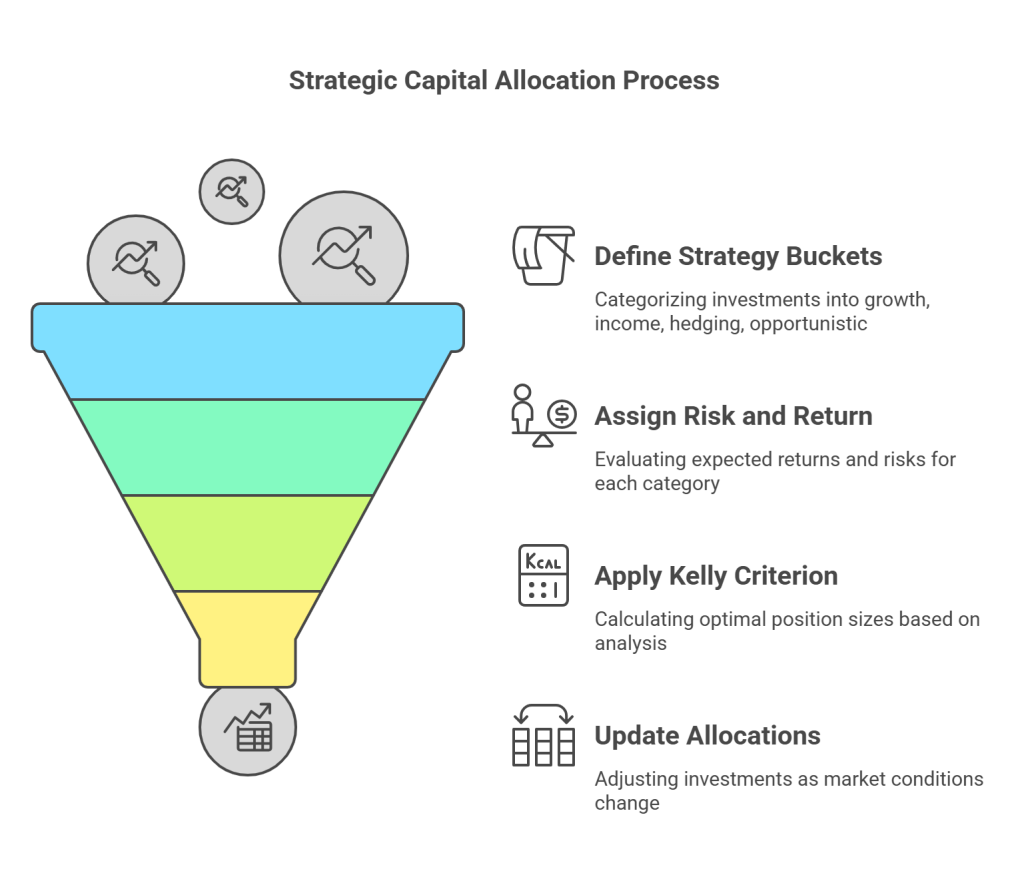
The Kelly Criterion is a mathematical formula for position sizing that calculates the optimal fraction of your portfolio to allocate to each investment. It maximizes long-term capital growth while minimizing the risk of ruin — replacing gut-based allocation with a precise, repeatable process grounded in probability theory. Key Takeaways What Is the Kelly Criterion—and Why

Kelly Criterion Position Sizing: Maximize Long-Term Returns While Avoiding Ruin Read More »

risk tolerance

Why Risk Tolerance Is the Single Most Underrated Edge in Value Investing

The Edge You’re Ignoring Could Be Costing You Millions. For value investors, risk is not the volatility in the market or in the stock price, but in fact it is how you react to it. Most investors obsess over metrics like price-to-earnings ratios, discounted cash flow models, or EBITDA margins. And yet, the biggest edge

Why Risk Tolerance Is the Single Most Underrated Edge in Value Investing Read More »

dividend etfs or stocks

Dividend ETFs vs. Building Your Own Portfolio: When to Choose Each

You want consistent, growing income. The kind that frees you from the anxiety of market volatility and makes your wealth feel real. You’ve probably considered dividend ETFs—the set-it-and-forget-it kind of investing that promises instant diversification and ease. But if you’re serious about compounding wealth through dividends, a deeper question remains: Should you build your own

Dividend ETFs vs. Building Your Own Portfolio: When to Choose Each Read More »

Scroll to Top