I want to tell you about one of the most counterintuitive ideas in all of investing, an idea so strange that when I first encountered it, I spent about an hour with a spreadsheet trying to convince myself it was wrong before I finally accepted that it was right.
It is called Shannon’s Demon. And once you understand it, you will never think about portfolio rebalancing the same way again.
Key Takeaways
- Shannon’s Demon demonstrates that rebalancing between volatile assets generates positive returns even when each individual asset has zero expected return
- This “rebalancing bonus” (also called volatility harvesting) is mathematically real and practically significant
- The bonus is larger when assets are more volatile and less correlated with each other
- Rebalancing converts volatility (usually thought of as pure risk) into a source of return
- The 5/25 rebalancing rule is a practical implementation that captures this bonus without trading too frequently
Who Was Claude Shannon?
Claude Shannon was the mathematician who essentially invented information theory: the mathematical framework underlying all modern digital communication, from the internet to your smartphone. He was also a legendary investor who reportedly compounded money at about 28% per year from 1966 to 1986, beating the market substantially.
Shannon developed what became known as Shannon’s Demon as a thought experiment to illustrate a counterintuitive property of volatile assets. He originally described it in lectures at MIT, though he never published it formally. The idea later appeared in the investment literature and became foundational to modern thinking about portfolio rebalancing and volatility harvesting.

The Thought Experiment: Two Assets With Zero Expected Return
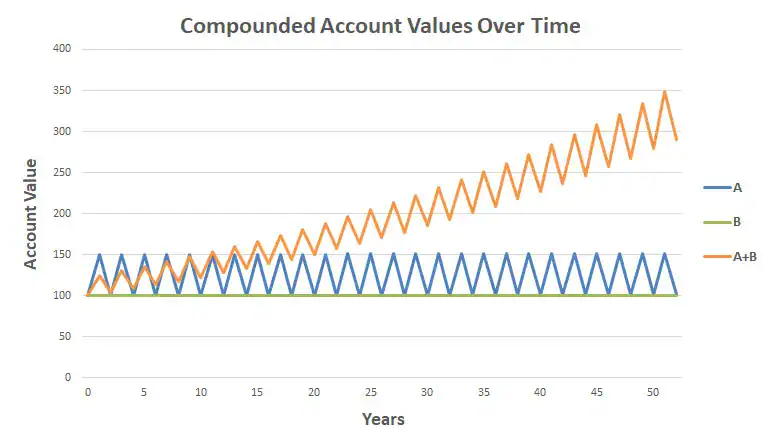
Here is Shannon’s original setup. Imagine two assets:
- Asset A: Each period, it either goes up 50% or goes down 33%, with equal probability (50/50)
- Asset B: Same thing, either up 50% or down 33% with equal probability
What is the expected long-run return of each asset held independently?
Let’s calculate. If the asset goes up 50% then down 33%, a $100 investment becomes $150, then $100.50, roughly back where it started. Actually, let’s be precise: $100 × 1.50 × 0.67 = $100.50. That is slightly positive, but for the purposes of the thought experiment, Shannon used symmetric up/down moves. Let us say the asset goes up 50% or down 33.33%, specifically so that up × down = 1 exactly. Then $100 × 1.50 × (2/3) = $100. Zero expected geometric return.
If you hold either asset by itself, you expect to go nowhere in the long run. You might have a good run, you might have a bad run, but the expected long-run value is unchanged. Both assets are, in expectation, coin flips to nowhere.
Now here is the astonishing part.
What if you invest 50% in each asset and rebalance back to 50/50 after each period?
Shannon showed, and you can verify in a spreadsheet in about ten minutes, that the rebalanced portfolio generates a positive expected return, even though both underlying assets have zero expected return.
Why This Happens: The Mathematics of the Rebalancing Bonus
The explanation lies in the difference between arithmetic and geometric returns.
When an asset goes up 50% and then down 33%, the arithmetic average return is (+50% + -33%) / 2 = +8.5%. But the actual geometric return, what you actually experience in your account, is zero (or slightly negative with exact symmetric moves). The gap between arithmetic and geometric return is called the variance drag, and it equals approximately half the variance of returns.
Rebalancing captures this variance drag and turns it into a source of positive return. Here is the intuitive mechanism:
When Asset A goes up sharply and Asset B goes down, rebalancing forces you to sell Asset A (which just went up) and buy Asset B (which just went down). When Asset B recovers and Asset A falls, you sell B and buy A. You are systematically buying low and selling high, not by predicting which asset will do well, but purely mechanically, by forcing a return to target weights.
Each rebalancing event locks in a small gain from the spread between the two assets. Over many periods, these small gains compound into a meaningful excess return over buy-and-hold.
This is the rebalancing bonus, also called volatility harvesting. You are, in effect, harvesting the volatility of your assets as a source of return.
A Concrete Numerical Example
Let me make this concrete. Suppose you have two assets, each with the up-50% / down-33% properties. You start with $100 in each ($200 total). Here are four possible sequences in period 1:
Scenario A: Both go up
$100 → $150 and $100 → $150. Total = $300. Rebalance to $150 each. No gain from rebalancing, but you are now 50% richer.
Scenario B: Both go down
$100 → $67 and $100 → $67. Total = $134. Rebalance to $67 each. Again, no gain from rebalancing itself.
Scenario C: Asset A up, Asset B down
$100 → $150 and $100 → $67. Total = $217. Rebalance to $108.50 each.
Now in period 2, if both mean-revert: Asset A down to $72.67 and Asset B up to $162.75. Total = $235.42.
Compare to buy-and-hold for the same sequence (A up then down, B down then up):
A: $100 × 1.50 × 0.67 = $100.50
B: $100 × 0.67 × 1.50 = $100.50
Total = $201.
Rebalanced portfolio: $235.42. Buy-and-hold: $201. That is an 17% difference from just two periods with a single rebalancing event.
The rebalancing bonus in this scenario is dramatic precisely because the assets moved in opposite directions and then partially reversed. Rebalancing forced you to buy the loser low and sell the winner high.
Scenario D: Asset A down, Asset B up
Symmetric to Scenario C, same rebalancing bonus applies.
Over many periods with randomly moving assets, the mixed scenarios (C and D) occur roughly half the time. Each one generates a small rebalancing bonus. Compounded over years and decades, the effect is substantial.
How Large Is the Rebalancing Bonus in Practice?
The theoretical rebalancing bonus depends on two factors: the volatility of the assets and the correlation between them.
Higher volatility = larger rebalancing bonus. More volatile assets create larger mispricings between target and actual weights, giving rebalancing more to harvest. This is counterintuitive: higher volatility, usually considered pure risk, becomes a source of return in a rebalanced portfolio.
Lower correlation = larger rebalancing bonus. When assets move independently or in opposite directions, the rebalancing events are more frequent and more significant. Assets that move in perfect lockstep provide no rebalancing opportunity at all.
Empirical studies have estimated the rebalancing bonus at roughly 0.5% to 1.5% per year for typical diversified portfolios. Over a 30-year investing horizon, that adds meaningfully to total wealth. Some studies focusing specifically on rebalancing across more volatile, less-correlated asset classes (like small-cap value vs. bonds vs. international stocks) have found larger bonuses.
Shannon’s Demon and My Investment Practice
I use this concept directly in how I manage my portfolio. Let me explain the connection to two specific tools.
The 5/25 Rebalancing Rule
I use the William Bernstein 5/25 rule as my trigger for rebalancing. The rule says: rebalance when an asset class drifts more than 5 percentage points from target (absolute trigger) or more than 25% of its target weight (relative trigger). This keeps me from trading too frequently on tiny drift while still capturing the rebalancing bonus when meaningful divergences occur.
This rule was developed independently of Shannon’s Demon as a practical heuristic, but it captures the same underlying logic: rebalance on meaningful divergences, not noise. The importance of rebalancing in portfolio management extends well beyond the rebalancing bonus to include risk management and discipline, but the bonus is real and worth capturing.
Rebalancing Within the Equity Portfolio
Beyond asset class rebalancing, I also apply this thinking within my equity portfolio. When a position I hold appreciates significantly and approaches my Kelly-optimal position size ceiling, I trim and redeploy into other underweighted positions. This is portfolio-level volatility harvesting: I am systematically selling what has run up and buying what has lagged, not because I believe in blind mean reversion but because my rebalancing rules force disciplined sell discipline that individual stock conviction often prevents.
The connection to Kelly Criterion position sizing is direct: Kelly tells me the optimal weight for each position, and Shannon’s Demon gives me the mathematical reason why systematically maintaining those weights, rather than letting winners run indefinitely, is sound long-run strategy.
What is interesting is that as an asset moves up in price, and assuming my original thesis stays valid, the expected future return declines (since the gap between the target price and the new price is now smaller). In this scenario, a recalculation of the Kelly weights will automatically result in lower allocation to this asset and higher allocation to another asset where the prices may have declined. In essence, a recalculation of Kelly weights forces you to rebalance and capture some of the rebalancing bonus.
Important Caveats
Shannon’s Demon does not mean rebalancing is always better than buy-and-hold in every specific historical period. There have been extended periods, particularly when one asset class dramatically outperforms another over many years, where buy-and-hold would have beaten a rebalanced portfolio in that specific period.
The theoretical advantage of rebalancing is a long-run expected return advantage, not a guaranteed outcome in any particular window. If you rebalance a diversified portfolio for 30 years, the probability that you capture a meaningful rebalancing bonus is high. If you do it for 3 years, you may or may not.
There are also transaction costs and tax implications to consider. In taxable accounts, rebalancing by selling appreciated positions triggers capital gains taxes. The rebalancing bonus must exceed these costs to be worth capturing, which is why I focus on rebalancing within tax-advantaged accounts where possible, and on using new contributions to rebalance in taxable accounts.
Value averaging is a related strategy that takes this concept further – adjusting contribution amounts to force more aggressive rebalancing during drawdowns. I have written about value averaging separately for those interested in more active approaches.
Why Most Investors Miss This
The rebalancing bonus is invisible in short periods. If you rebalanced your portfolio last quarter and the quarter before that, you probably cannot look at your returns and identify which basis points came from the rebalancing bonus versus market returns. The mechanism is real but diffuse, operating across hundreds of small transactions over many years.
This invisibility is part of why rebalancing remains psychologically difficult. When markets are rising, rebalancing means selling winners. It feels wrong. When markets are falling, rebalancing means buying losers. It also feels wrong. The math says you should do both. But the math does not feel like anything. Your losses feel like mistakes, and your winners feel like genius. Rebalancing forces you to act against both feelings simultaneously.
Understanding Shannon’s Demon does not make this easy. But it does make it rational. You are not selling your winners because you lack conviction. You are selling your winners because the mathematics of long-run wealth accumulation tells you that maintaining diversification and systematically buying low beats the concentrated bet that your recent winner will keep winning.
For the psychological dimension of staying disciplined through difficult markets, my article on portfolio drawdown management addresses the behavioral challenges directly. Also one thought helps me stick to the rebalancing discipline: you are not buying or selling entire positions. You are only trimming or adding small incremental positions. A large part of your position will continue to enjoy the run
The Portfolio Architecture Conclusion
Shannon’s Demon is not a trading strategy. It is a principle that should shape how you think about portfolio architecture:
- Hold assets that are genuinely volatile and less than perfectly correlated
- Set target weights that reflect your risk tolerance and return objectives
- Rebalance on meaningful drift, not constantly and not never
- Harvest the volatility of your holdings as a compounding return engine over time
Combined with sound asset allocation strategy and position sizing via the Kelly Criterion, Shannon’s Demon provides one more mathematical argument for the disciplined, systematic approach to portfolio management that has always been at the heart of serious value investing.
Subscribe to My Free Newsletter
I write weekly about value investing, portfolio construction, and the mathematical ideas that underpin sound long-run investment strategy. Subscribe to my free newsletter below.
If you want to see how I apply these ideas with real money including my live portfolio, position sizes, and the rebalancing events I execute, the Inner Circle membership gives you full transparency into my actual process.
Disclosure: I may hold positions in some of the stocks mentioned as examples in this article.
Image Source: Portfolio Charts

Shailesh Kumar, MBA is the founder of Astute Investor’s Calculus, where he shares high-conviction small-cap value ideas, stock reports, and investing strategies. He is also a strategy and operations consultant focused on measurable business outcomes
His work has been featured in the New York Times and profiled on Wikipedia. He previously ran Value Stock Guide, one of the earliest value investing platforms online.
Subscribe to the Inner Circle to access premium stock reports and strategy insights.
Featured in: