Most investors spend enormous effort deciding which stocks to buy and almost no effort deciding how much to buy. That is exactly backwards. In the long run, position sizing will have as much impact on your returns as stock selection and it will have more impact on your survival as an investor.
I use the Kelly Criterion as the mathematical foundation for position sizing in my portfolio. But when I tell people this, the first thing I have to clarify is: I do not use full Kelly. Nobody rational uses full Kelly in practice. Let me explain why, and what I use instead.
Key Takeaways
- Full Kelly maximizes long-run geometric growth rate in theory, but it produces catastrophic drawdowns that are psychologically and financially unsustainable
- Fractional Kelly (typically half-Kelly) sacrifices a modest amount of expected return in exchange for dramatically reduced volatility and drawdown
- The Kelly formula requires honest probability estimates; overconfidence in your edge leads to overbetting, which is ruinous
- I use between quarter-Kelly and half-Kelly for most positions, adjusting toward higher fractions for my highest-conviction ideas
- Position sizing is not just mathematics, it must account for the limits of human psychology and the uncertainty in your own estimates
The Kelly Criterion: A Quick Foundation
Before I get into full versus fractional Kelly, let me lay the groundwork. If you want the full mathematical treatment, I have a dedicated article on the Kelly Criterion and a separate piece on Kelly Criterion position sizing that covers the mechanics in detail.
The Kelly formula for a simple binary bet is:

f* = (bp – q) / b
Where:
- f* = the fraction of your portfolio to bet
- b = the net odds received on the bet (how much you win per dollar risked)
- p = the probability of winning
- q = the probability of losing (1 – p)
For stock investing, the standard adaptation is:
f* = (p × W – q × L) / (W × L)
Where W is the expected gain if you are right and L is the expected loss if you are wrong.
If I think a stock has a 65% chance of returning 50% and a 35% chance of losing 25%, the Kelly fraction is:
f* = (0.65 × 0.50 – 0.35 × 0.25) / (0.50 × 0.25) = (0.325 – 0.0875) / 0.125 = 0.2375 / 0.125 = 1.9 or 190%
Wait! 190% of portfolio? That cannot be right for a stock investment. And that is exactly the first lesson about full Kelly: in stock investing, the Kelly formula very often suggests leverage, and following that recommendation literally would be insane.
What Full Kelly Actually Means in Practice
Full Kelly is the position size that mathematically maximizes the expected geometric growth rate of your wealth over many repeated bets. The mathematics is elegant and correct. John Kelly’s 1956 paper at Bell Labs proved it rigorously.
The problem is not the math. The problem is what full Kelly feels like while you are living through it.
At full Kelly sizing, you will experience drawdowns that are proportional to the Kelly fraction you are playing. A portfolio running full Kelly strategy will routinely see drawdowns of 50% or more during losing streaks even when the underlying edge is real and the math is right. This is not a flaw in the theory; it is baked into the optimal growth formulation.
Think about what a 50% drawdown requires to recover: a 100% gain just to get back to even. A 60% drawdown requires a 150% gain. These are the type of experiences that cause real investors to abandon their strategies at exactly the wrong moment.
The other problem with full Kelly is that it assumes your probability estimates are precisely correct. In a casino, this is roughly true. You know the house edge on blackjack or roulette to many decimal places. In stock investing, your probability estimates are just that: estimates, informed by analysis but uncertain. If you think an investment has a 65% chance of working out and it is really 58%, your full Kelly bet is badly wrong. The formula is extremely sensitive to input errors.
(Note: this is where a deep experience in estimating intrinsic values comes in. You are unlikely to be 100% correct, but with experience you improve your accuracy significantly).
The Case for Fractional Kelly
Fractional Kelly means betting some fraction of the full Kelly amount. Typically this is half-Kelly (50% of the Kelly-recommended size), though quarter-Kelly and three-quarter-Kelly are also used.
The mathematics of fractional Kelly are well studied, and the results are striking. At half-Kelly:
- Expected geometric growth rate falls by only about 25% compared to full Kelly
- Variance (volatility of outcomes) falls by 75%
- Maximum drawdowns are roughly half as severe
That is a remarkable trade-off. You give up roughly one-quarter of the theoretical optimal growth rate in exchange for cutting your worst-case drawdowns in half and reducing portfolio volatility by three-quarters. Almost every rational investor should take that deal.
This is why in my article on Buffettology and the Kelly Criterion, I make the point that even investors who are highly confident in their analysis should think carefully about the fraction they apply to their Kelly estimates.
Why I Use Between Quarter-Kelly and Half-Kelly
In my personal portfolio, which Inner Circle members can see in real time, I use a Kelly fraction that varies between 0.25x and 0.5x depending on my conviction level. Let me explain the logic.
The estimation error problem. When I calculate a Kelly fraction for a stock, I am making assumptions about both the probability of success and the magnitude of the outcome. Both of those estimates contain uncertainty. If my true edge is smaller than I think, full Kelly would be catastrophically overbetting. By using fractional Kelly, I am essentially building in a margin of safety on my own analytical fallibility. Given my background and process, I think my probability estimates are probably more accurate than a naive guess. But more accurate is not the same as perfectly accurate.
The correlation problem. My positions are not statistically independent the way casino bets are. If the market falls 30%, almost all of my small-cap value positions will fall simultaneously regardless of their individual merits. The Kelly formula assumes independence of bets. When bets are correlated, the appropriate Kelly fraction is lower. While I take great pains to adjust the Kelly allocations to account for correlations, it is not enough. Correlations after all are backward looking metric and they evolve with time.
The psychology problem. Even if I am mathematically correct about my edge, I still have to live through the drawdowns that Kelly-sized positions produce. If my position sizing creates drawdowns that cause me to panic and sell at lows, then my theoretical edge is worthless. Position sizing must account for my actual psychological limits, not just my theoretical risk tolerance.
For more on managing the psychological dimension of drawdowns, see my article on portfolio drawdown management.
How I Adjust Fractions by Conviction Level
My conviction level based on the depth of my research, the quality of the catalyst, and the completeness of my understanding of the business influences where within my quarter-to-half-Kelly range I size a position.
High-conviction positions (targeting ~0.4x to 0.5x Kelly):
These are situations where I have done extensive research, the thesis is clear, the catalyst is identifiable and near-term, the balance sheet is strong, and the Piotroski score is 8 or 9. I have high confidence in both my probability estimate and my estimate of the outcome range. These positions get sized toward the upper end of my fractional Kelly range.
In reality, if the Kelly allocations recommend leveraging, I scale the calculated Kelly allocations down to fit the portfolio size because I do not leverage. Sometimes the scaling can be deeper and I might end up with only 0.3x Kelly. These are some of the practicalities you have to build around how you want to manage your portfolio and where you draw the line. Regardless of the fraction used, it is important to note that the whole portfolio is Kelly adjusted. This means it is optimally constructed to minimize risk and maximize profit within the bounds you set for your portfolio.
Exploratory positions (targeting ~0.2x to 0.25x Kelly):
Occasionally I buy a small position in a situation I find interesting but do not yet understand fully or perhaps because it is a special situation play. Small Kelly fractions let me participate without betting large on ideas where expected returns are not well defined.
The Danger Zone: Overbetting
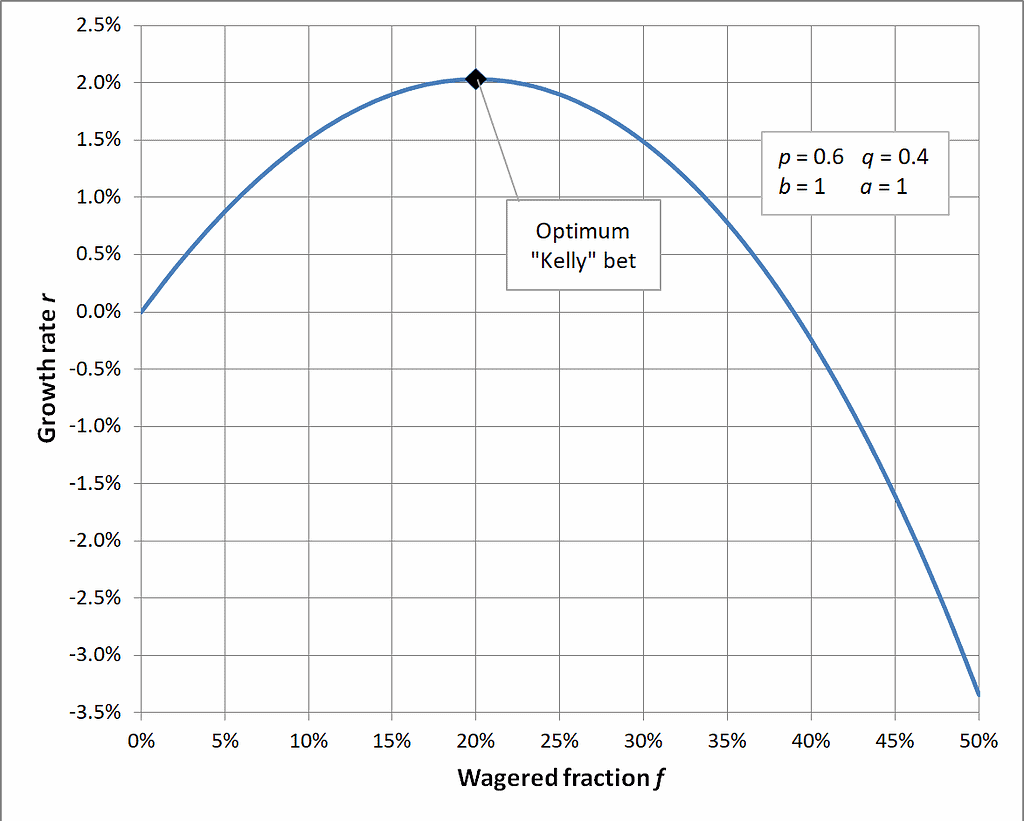
The opposite of full Kelly is ruin, not just underperformance. When you bet more than the Kelly-optimal amount, expected geometric growth actually turns negative; you are mathematically certain to go broke with probability approaching 1 over enough trials, even with a genuine edge.
This is not intuitive. Most people think overbetting just means more risk and more return. It does not. Beyond the Kelly optimum, expected long-run returns fall. Beyond 2x Kelly, you are mathematically worse off than not betting at all. This is the deeper reason I think about fractional Kelly not as leaving money on the table but as the rational response to estimation uncertainty.
The anti-Martingale strategy literature covers some related concepts about position sizing in sequence, though from a different angle.
A Worked Example: Applying Fractional Kelly to a Real Situation
Let me illustrate with a realistic scenario. Suppose my analysis of a small-cap industrial company gives me the following estimates:
- Probability the stock doubles within 3 years: 60%
- Probability the stock falls 40% and stays there: 40%
- Expected win: 100% gain
- Expected loss: 40% loss
Kelly fraction: f* = (0.60 × 1.00 – 0.40 × 0.40) / (1.00 × 0.40) = (0.60 – 0.16) / 0.40 = 0.44 / 0.40 = 1.10 or 110%
Again, full Kelly is suggesting more than a 100% position, essentially leverage. This is a common outcome with Kelly in stock investing because stocks have asymmetric payoff profiles.
Applying my half-Kelly approach: 1.10 × 0.5 = 55% of portfolio. Still very high. Applying quarter-Kelly: 1.10 × 0.25 = 27.5% of portfolio.
In practice, One may also impose a hard maximum position size of 15–20% of portfolio regardless of what Kelly calculates. Large Kelly fractions in individual stocks reflect both the attractive expected return and the high uncertainty in the estimates. The hard cap prevents any single position from becoming ruinous if the analysis is simply wrong. If you choose to scale down further, ensure that you scale all your positions by the same factor so your adjustments for correlations stay consistent.
Connecting Kelly to My Overall Risk Management Framework
Kelly determines position size, but it works within a broader risk framework. I always want to know:
- What is the maximum drawdown this position could cause at the portfolio level?
- How does this position correlate with my other holdings?
- What is my rebalancing trigger if it moves significantly in either direction?
For that broader framework, my article on risk tolerance in value investing covers the conceptual foundation, and my piece on Shannon’s Demon and the rebalancing bonus connects Kelly-based sizing to portfolio rebalancing mechanics.
The Bottom Line on Full Kelly vs. Fractional Kelly
Full Kelly is theoretically optimal for an investor who:
- Has perfectly accurate probability estimates
- Has perfectly correlated independent bets
- Has infinite psychological tolerance for drawdowns
- Has no estimation uncertainty whatsoever
No such investor exists. Fractional Kelly, specifically in the range of half to quarter Kelly, is the rational approach for actual human investors operating with real analytical uncertainty. You give up modest theoretical return in exchange for dramatically better risk-adjusted outcomes and, critically, the psychological resilience to stay with your strategy through inevitably difficult periods.
The specific fraction matters less than consistently applying some fraction and not drifting toward the full Kelly sizing that feels correct when you are most excited about an idea.
Subscribe to My Free Newsletter
Position sizing is one of the most underappreciated topics in investing. I write regularly about Kelly Criterion applications, portfolio construction, and value investing ideas in my free weekly newsletter. Subscribe below to get it delivered to your inbox.
Inner Circle members get access to my live portfolio with the actual Kelly fractions applied to each position so you can see exactly how I put this framework into practice with real money.
Disclosure: I may hold positions in some of the stocks mentioned as examples in this article.
Image: By Zojj – Own work, CC BY-SA 4.0, https://commons.wikimedia.org/w/index.php?curid=108576800

Shailesh Kumar, MBA is the founder of Astute Investor’s Calculus, where he shares high-conviction small-cap value ideas, stock reports, and investing strategies. He is also a strategy and operations consultant focused on measurable business outcomes
His work has been featured in the New York Times and profiled on Wikipedia. He previously ran Value Stock Guide, one of the earliest value investing platforms online.
Subscribe to the Inner Circle to access premium stock reports and strategy insights.
Featured in: